

To master WoW raids, you’ll need a thorough strategy. Start by thoroughly preparing your team, optimizing gear, and researching boss mechanics. Effective communication is essential, so establish clear protocols and practice non-verbal cues. Understand your class role inside out and maintain situational awareness during encounters.
Adapt quickly to unexpected challenges and consistently analyze your performance for improvement. Build a cohesive team with strong dynamics, fostering a positive environment that celebrates successes. By focusing on these key areas, you’ll greatly enhance your raid performance. Dive deeper to uncover the nuances that separate good raiders from great ones.
Key Takeaways
- Thoroughly prepare raids by analyzing team composition, assigning roles, and stocking up on consumables.
- Master effective communication techniques, including clear voice protocols and non-verbal signaling systems.
- Study and understand boss mechanics, including abilities, phase changes, and positioning strategies.
- Optimize gear, enchants, and consumables based on class roles and encounter requirements.
- Develop strong situational awareness and adaptability to handle unexpected challenges during raids.
Raid Preparation Essentials
Every successful raid begins long before you step foot in the instance. Strategic planning is essential, involving meticulous resource management and careful role assignments. You’ll need to analyze your team’s composition, ensuring a balanced mix of classes and specializations. Make smart itemization choices, focusing on gear that complements your role and enhances overall build synergy.
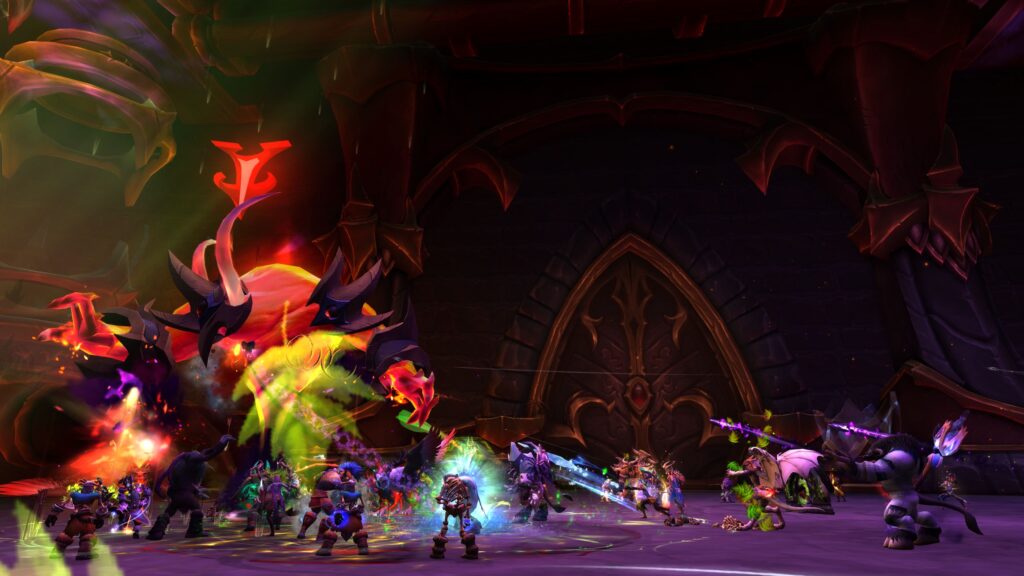
Time management is key. Set up a raid schedule that works for everyone and stick to it. Utilize addons and tools to track cooldown coordination, allowing for seamless execution of vital abilities during encounters. Practice team cohesion through regular communication and joint activities outside of raids.
Before the raid, stock up on consumables, repair your gear, and familiarize yourself with boss mechanics. Assign responsibilities for crowd control, interrupts, and dispels. Develop clear communication protocols for callouts and emergencies. Create and distribute loot distribution rules to prevent conflicts.
Effective Communication Techniques
Effective communication is the cornerstone of successful raiding in World of Warcraft. You’ll need to establish clear voice chat protocols to guarantee everyone understands when and how to speak during encounters. Implement raid warning best practices and non-verbal signaling systems to convey critical information quickly and efficiently, especially during intense combat situations.
Clear Voice Chat Protocols
Clear voice chat protocols are the foundation of successful raid communication in World of Warcraft. Establish a set of rules that everyone must follow to guarantee efficient information exchange during intense encounters. Implement a push-to-talk system to minimize background noise and unnecessary chatter. Designate specific raid members, such as the raid leader and healers, to have priority speaking rights during pivotal moments.
Utilize voice modulation tips to enhance clarity. Speak at a moderate pace, enunciating your words clearly. Avoid shouting, which can distort your voice and cause confusion. Instead, focus on clear message delivery by maintaining a steady, authoritative tone. When calling out important information, use concise phrases and repeat critical instructions twice.
Create standardized callouts for common raid mechanics and assign specific players to announce them. This consistency helps raiders quickly process and react to information. Encourage raiders to acknowledge important instructions with brief confirmations. Establish a system for emergency communications, such as a specific keyword that immediately silences all chatter. By adhering to these protocols, you’ll foster a more organized and effective raiding environment.
Raid Warning Best Practices
While voice chat is essential for real-time communication, raid warnings provide an important visual component that can’t be overlooked. To maximize their effectiveness, you’ll need to master various raid warning types and implement them with precision.
| Raid Warning Type | Best Practice |
|---|---|
| Boss Abilities | Use 5-10 seconds before cast |
| Phase Changes | Alert 15-20 seconds prior |
| Positioning | Provide clear, concise directions |
| Cooldown Usage | Specify ability and target |
| Emergency Actions | Use caps and multiple exclamation points |
Effective timing is vital for raid warnings. Issue alerts early enough for players to react, but not so far in advance that they’re forgotten. Message clarity is paramount; use concise, unambiguous language to convey instructions. Incorporate alert sounds to grab attention, but don’t overuse them to avoid desensitizing your team.
Visual cues, such as icons or color-coding, can enhance warning visibility. Consistently use these elements to help players quickly identify and respond to different types of alerts. Monitor player response to your warnings and adjust your approach as needed. Remember, the goal is to provide timely, actionable information that enhances raid performance without overwhelming your team.
Non-Verbal Signaling Systems
Mastery of non-verbal signaling systems can elevate your raid team’s communication to new heights. In high-pressure raid environments, relying solely on voice communication can be limiting. Implementing gesture signals and visual hand signals allows for quick, silent alerts that don’t disrupt concentration or overwhelm voice channels.
Develop a set of standardized body language cues that your team can recognize instantly. Use eye contact and player cues to convey urgent information or coordinate complex maneuvers. These non-verbal cues are essential for maintaining raid synchronization, especially during intense boss encounters.
Enhance your team’s spatial awareness by establishing clear visual indicators for positioning and movement. Utilize in-game markers, player icons, or even character animations as silent alerts for specific actions or phases. This approach improves team dynamics and reduces the cognitive load on raid members.
Practice and refine your non-verbal communication system regularly. Encourage team members to provide feedback and suggest improvements. As your raid group becomes more adept at interpreting these signals, you’ll notice a significant boost in overall performance and coordination. Remember, effective non-verbal communication is a skill that requires constant refinement and adaptation to new raid challenges.
Understanding Boss Mechanics
Understanding boss mechanics is the cornerstone of successful raiding in World of Warcraft. To master raid encounters, you’ll need a thorough boss abilities overview and encounter mechanics breakdown. Start by studying each boss’s key abilities, phase changes, and unique mechanics.
| Mechanic Type | Strategy |
|---|---|
| AoE Damage | Use cooldowns, spread out |
| Tank Swaps | Taunt at specific debuff stacks |
| Add Management | Prioritize targets, use CC |
Positioning tactics play a vital role in raid success. You’ll need to quickly adapt to fight-specific requirements, whether it’s stacking, spreading, or executing complex movement patterns. Damage mitigation strategies are essential; learn when to use personal and raid-wide defensive cooldowns.
Effective debuff management tips include coordinating cleanses, using immunities, and timing dispels. Pay attention to phase change insights, as these often introduce new mechanics or intensify existing ones. Develop raid-specific strategies for each encounter, considering your group’s composition and strengths.
Optimizing Gear and Consumables
To maximize your raid performance, you’ll need to focus on optimizing your gear and consumables. Start by researching and acquiring your Best-in-Slot (BiS) gear, then enhance it with the most effective enchants and gems for your class and role. Finally, prepare a stock of appropriate pre-raid consumables, such as flasks, food buffs, and potions, to guarantee you’re fully equipped for the challenges ahead.
Best-In-Slot Gear Selection
Gear optimization stands at the heart of successful raiding in World of Warcraft. To select the best-in-slot (BiS) gear, you’ll need to understand your class’s stat priority breakdown and develop effective gear acquisition strategies. Focus on raid preparation gear that aligns with your role and spec, whether it’s through crafting best in slot items or farming specific dungeons.
Currency management tips are essential for prioritizing gear upgrades. Save your resources for pieces that offer the most significant improvements. Ideal enchant selections and gem choices can further enhance your gear’s performance. When it comes to gear upgrades timing, consider your raid group’s progress and upcoming boss fights.
Navigate group loot dynamics by communicating your needs clearly and respecting your teammates’ priorities. Don’t overlook vendor items usage, as some pieces can be surprisingly effective. Always keep alternative gear options in mind for different encounter types or stat requirements.
Enchants and Gems Optimization
Enhancing your gear through perfect enchants and gems is essential for pushing your character’s performance to its limits. To improve your raid setup, you’ll need to follow an extensive enchants guide and understand gemming basics. Start by identifying your class and spec’s stat priorities, then select enchants and gem choices that align with these needs.
When crafting enhancements, consider the synergy between your gear pieces and how each enchant contributes to your overall performance. Don’t overlook racial benefits that might influence your itemization strategies. Improvement techniques include balancing primary and secondary stats, meeting specific breakpoints, and maximizing benefits from set bonuses.
Keep in mind that enchanting costs can add up quickly, so prioritize your most impactful gear slots first. For gems, focus on socket bonuses only if they provide a considerable advantage over raw stat gains. Remember that some raid setups may require specific enchants or gems to meet certain thresholds or mechanics.
Regularly review and update your enchants and gems as you acquire new gear to maintain peak performance. By mastering these aspects of gear improvement, you’ll greatly boost your effectiveness in raids.
Pre-Raid Consumables Preparation
Beyond enchants and gems, consumables play a key role in maximizing your raid performance. To guarantee you’re fully prepared, create a thorough checklist of essential items. Focus on buff food options that align with your class and role, considering raid buff synergy. Don’t overlook the importance of elixir effects, which can greatly boost your stats or provide unique benefits.
- Flask or battle elixir
- Guardian elixir
- Buff food
- Potions (combat and utility)
- Weapon oils or stones
Understand potion timings and item cooldowns to optimize their use during encounters. Pre-plan your consumable refresh strategy, especially for longer raids. Manage your resources efficiently by using class-specific consumables that complement your abilities.
Before boss pulls, double-check your buffs and consumables. Use pre-pull rituals to maximize your opening burst. Remember that some consumables don’t stack, so prioritize those with the highest impact. Keep a stock of utility items like healthstones and mana gems for emergencies. By mastering consumable preparation and usage, you’ll greatly enhance your raid performance and contribute more effectively to your team’s success. Stay adaptable and adjust your consumable strategy based on specific encounter requirements and your raid group’s needs.
Mastering Your Class Role
Understanding your class role is fundamental to raid success. To excel, you must thoroughly comprehend your character’s strengths, weaknesses, and unique abilities. Focus on mastering your rotation, prioritizing the most effective abilities for different situations. Study class guides, theorycrafting resources, and top players’ strategies to optimize your performance.
Class synergy optimization is essential in raids. Learn how your abilities complement other classes and communicate with your team to maximize collective effectiveness. For example, coordinate cooldowns with other players to amplify damage output or survivability during critical moments.
Utilize role-specific addons to enhance your performance. These tools can provide significant information, such as tracking important buffs, debuffs, or cooldowns, allowing you to make split-second decisions. Customize your user interface to display essential information prominently, reducing reaction time and improving situational awareness.
Practice your role in various scenarios, including solo play, dungeons, and lower-difficulty raids. This will help you internalize your abilities and develop muscle memory for complex rotations. Stay updated on class changes and raid mechanics to adapt your strategies accordingly. By continuously refining your skills and knowledge, you’ll become an indispensable asset to your raid team.
Raid Awareness and Positioning
Mastering your class role sets the foundation for raid success, but raid awareness and positioning elevate your performance to the next level. Understanding raid flow and encounter awareness are essential for anticipating enemy telegraphs and coordinating movement with your team. Develop positioning tactics that maximize your effectiveness while minimizing risks. Practice awareness drills to sharpen your reflexes and improve your ability to react quickly to changing situations.
Key aspects of raid awareness and positioning include:
- Terrain utilization for cover and strategic advantage
- Role-specific positioning to enhance abilities and support teammates
- Sightlines management to maintain visual contact with enemies and allies
- Spacing awareness to avoid overlap of area-of-effect abilities
- Movement coordination to execute complex strategies efficiently
Implement these concepts by studying encounter mechanics, communicating with your raid team, and constantly adapting to the evolving battlefield. Pay attention to visual and audio cues that signal incoming attacks or phase shifts. Adjust your position proactively to maintain peak performance and survivability. By mastering raid awareness and positioning, you’ll contribute more effectively to your team’s success and elevate your overall raiding experience in World of Warcraft.
Adapting to Unexpected Situations
Chaos is inevitable in World of Warcraft raids, and your ability to adapt to unexpected situations can make or break your team’s success. Developing adaptive strategies and flexible tactics is essential for overcoming unforeseen challenges. Cultivate your improvisation skills and practice quick decision-making to effectively manage crises as they arise.
Enhance your situational awareness by constantly monitoring the battlefield, your teammates’ positions, and enemy movements. This heightened awareness will allow you to anticipate potential problems and react swiftly. When unexpected events occur, communicate clearly with your team to coordinate your response.
Focus on building team resilience by encouraging a positive attitude towards setbacks and fostering a culture of adaptability. Train your raid group to switch roles or adjust strategies on the fly, ensuring everyone is prepared for various scenarios. Regularly review and discuss past encounters to identify areas for improvement and develop contingency plans.
Analyzing and Improving Performance
Success in WoW raids hinges on continuous improvement, and you’ll need to analyze your performance meticulously to achieve it. Utilize performance metrics to track your progress and identify areas for growth. Implement player accountability by reviewing damage output and healing efficiency after each encounter. Establish feedback loops within your team to foster open communication and facilitate rapid strat adjustments.
To enhance your raid performance, focus on:
- Analyzing encounter logs for ideal skill rotations
- Evaluating team dynamics and role synergy
- Conducting thorough post-raid reviews
- Identifying and addressing individual weaknesses
- Implementing targeted practice sessions
Dive deep into encounter analysis to understand the nuances of each fight. This knowledge will enable you to fine-tune your approach and maximize your contribution to the raid. Pay close attention to team dynamics, as successful raids rely on seamless coordination between all members. Regularly assess your performance against established benchmarks and set specific, achievable goals for improvement.
Don’t shy away from constructive criticism; embrace it as an opportunity for growth. By consistently analyzing and refining your gameplay, you’ll steadily enhance your skills and become an invaluable asset to your raid team.
Building a Successful Raid Team
While individual performance is essential, a truly successful raid team is built on a foundation of cohesion, communication, and shared goals. To achieve this, you must focus on role diversity, guaranteeing your team has a balanced mix of tanks, healers, and DPS players. Aim for team synergy by selecting members whose playstyles and personalities complement each other.
Strong leadership dynamics are vital. Appoint raid leaders who can make quick decisions and implement strategic delegation to maximize efficiency. Develop effective conflict resolution skills to address disagreements swiftly and maintain team harmony. Implement robust recruitment strategies to continually bring in skilled players who align with your team’s vision.
Don’t underestimate the importance of morale boosting activities. Regular team-building exercises and celebrating successes can greatly improve group cohesion. Establish clear accountability measures to guarantee all members are contributing their best efforts. Set benchmarks for performance and attendance, and address shortcomings promptly.
Frequently Asked Questions
How Do I Find a Raid Group That Fits My Schedule?
You might think finding a raid group that fits your schedule is impossible, but it’s actually quite achievable. Start by utilizing community resources and online platforms like recruitment websites and local guild forums. Consider your time zone and look for groups offering flexible raiding options. Don’t limit yourself to fixed schedules; explore communities that accommodate various time slots. Join in-game chat channels and social media groups dedicated to scheduling raids. Be proactive in communicating your availability and preferences to potential raid teams.
What Addons Are Essential for Raiding in World of Warcraft?
To excel in WoW raiding, you’ll need essential addons. Install boss mods like DBM or BigWigs for encounter warnings. Use cooldown trackers to manage your abilities effectively. Healing and damage meters help you gauge performance. Encounter guides provide visual cues for mechanics. Raid timers keep you on schedule. Don’t forget voice communication addons for coordination. Finally, consider loot distribution tools to streamline rewards. These addons will enhance your situational awareness, improve decision-making, and boost overall raid performance.
How Can I Overcome Raid Anxiety as a New Player?
Oh, sure, raid anxiety is just a myth perpetuated by casual players, right? Wrong! You can conquer it, though. Start with breathing techniques to calm your nerves. Use positive affirmations like “I’ve got this” before raids. Preparation is key: study boss mechanics and optimize your gear. Find a mentor for support and guidance. Remember, everyone starts somewhere. With practice and persistence, you’ll transform from a nervous newbie to a confident raider. Embrace the challenge and watch your anxiety fade.
Are There Any Raid Etiquette Rules I Should Know About?
You should be aware of several raid etiquette rules. First, master communication tips to effectively coordinate with your team. Understand your role responsibilities and come prepared for the raid. Be familiar with boss strategies before joining. Respect the group dynamics and contribute positively. Follow loot distribution rules set by your raid leader. If conflicts arise, practice constructive conflict resolution. Always be punctual, attentive, and ready to adapt. Remember, a successful raid requires everyone’s cooperation and respect for these unwritten rules.
How Do I Balance Raiding With Other Aspects of My Life?
You’ll find that balancing raiding with life requires mastering time management and setting clear boundaries. Prioritize your personal commitments and assess your raid commitment realistically. Develop a flexible schedule that accommodates your social life and other responsibilities. Be honest with your raid team about your availability and don’t overextend yourself. Use tools to track your time spent gaming and adjust as needed. Remember, your real-life priorities should always come first, so don’t hesitate to step back if raiding becomes overwhelming.
Conclusion
You’ve now gained the tools to excel in WoW raids. Remember, success isn’t just about individual skill—it’s about teamwork. Curiously, top guilds spend an average of 16 hours per day progressing on new raid content. While that’s extreme, your dedication will pay off. Stay focused, adapt quickly, and never stop improving. With these strategies, you’ll conquer even the toughest encounters. Now go forth and claim your epic loot!
Come to my blog, regardless of race or faction, for Azeroth’s sake!